Relational Databases & SQL Quizzes
SQL Quiz
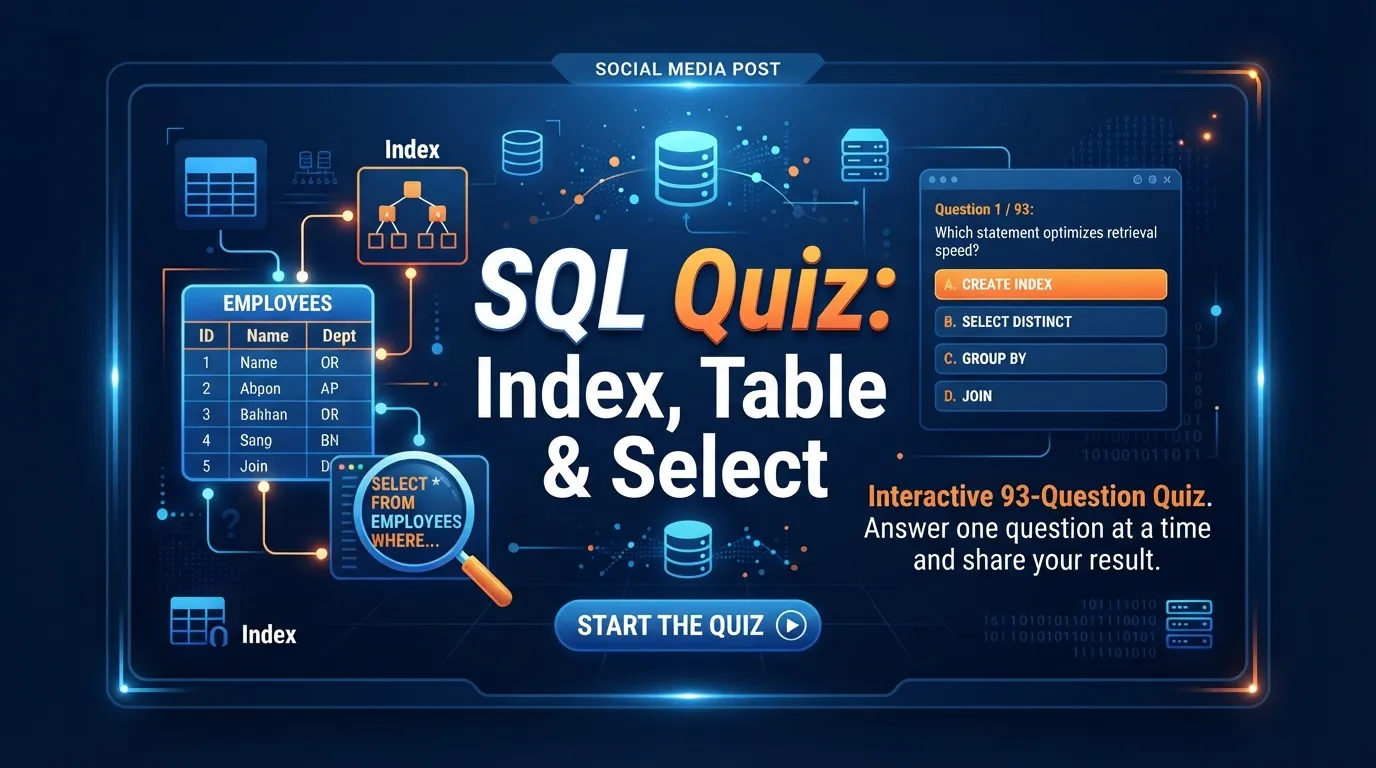
SQL Quiz: Index, Table & Select: interactive 93-question quiz. Answer one question at a time and share your result.
Test your expertise in MySQL database fundamentals, performance tuning, and stored procedures. This quiz features 30 randomized questions from a bank of 64, designed to challenge your practical knowledge. Click 'Start Quiz' to assess your skills and discover your current rank!
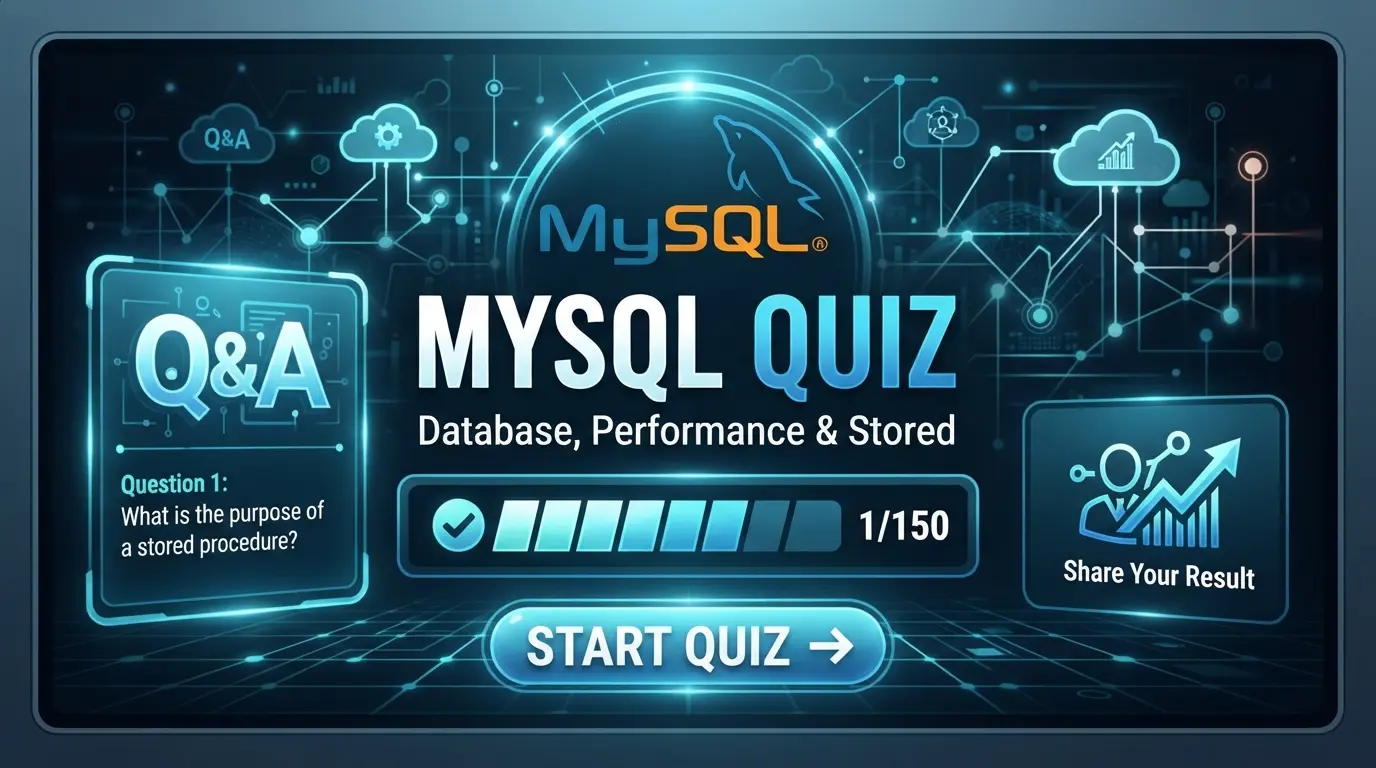
Welcome to the Jawda interactive MySQL Quiz! This assessment is meticulously designed to evaluate your practical understanding of core MySQL concepts, ranging from fundamental database definitions and SQL usage to advanced topics like performance optimization and the implementation of stored procedures. Whether you're a student looking to solidify your knowledge, a developer preparing for a technical interview, or a database administrator aiming for self-evaluation and skill validation, this quiz provides a robust measure of your competency. It specifically tests your ability to apply MySQL principles in real-world scenarios, identify best practices, and troubleshoot common issues.
Each attempt at this quiz presents you with 30 unique questions, randomly drawn from a comprehensive bank of 64. All questions are in a multiple-choice format, requiring you to select the best answer from the given options. Upon answering, you'll receive immediate feedback, indicating whether your choice was correct or incorrect, along with a concise explanation to reinforce your learning. Your score is calculated based on the number of correct answers. There's no limit to how many times you can retake the quiz, allowing you to re-test your knowledge, encounter new questions, and strive for a perfect 100% score to achieve the coveted 'Expert' rank.
To excel in this quiz, a solid grasp of the following high-yield concepts is essential:
my.cnf).systemctl vs. process killing).This section covers the bedrock of relational databases and SQL within MySQL.
| Concept | Description & MySQL Relevance |
|---|---|
| Database Definition | A structured collection of data. In MySQL, it's a logical container for tables, views, etc. |
| SQL Usage | Structured Query Language for managing and manipulating relational databases. Essential for SELECT, INSERT, UPDATE, DELETE, CREATE, ALTER. |
| Denormalization | Intentionally introducing redundancy to improve read performance, often at the cost of write performance and data integrity complexity. |
| Relationship Types | One-to-One, One-to-Many, Many-to-Many relationships between tables, crucial for database design. |
Optimizing and monitoring MySQL instances is a critical skill.
SHOW STATUS, EXPLAIN).Ensuring data safety and availability.
mysqldump).cron.Enhancing database functionality and efficiency.
IF, CASE, loops).Be aware of these common pitfalls that often trip up learners:
my.cnf file takes precedence when multiple exist. Remember the order of loading.systemctl stop mysql and abruptly terminating the mysqld process is crucial for data integrity.Your quiz score provides immediate feedback on your MySQL proficiency:
| Score Range | Rank Tier | What It Means & Next Steps |
|---|---|---|
| 0-21 points | Beginner | You're just starting your MySQL journey. Focus on foundational concepts like database definition, basic SQL commands, and installation. Review the explanations for incorrect answers and revisit introductory MySQL resources. Retake the quiz to reinforce learning. |
| 22-63 points | Intermediate | You have a solid understanding of MySQL fundamentals and some advanced topics. To reach the next level, concentrate on areas like performance tuning, advanced SQL queries, and stored procedures. Pay attention to the 'Key Concepts Tested' section and challenge yourself with more complex scenarios. |
| 64 points | Expert | Congratulations! You possess a comprehensive and deep understanding of MySQL database management, performance optimization, and stored routines. You're well-prepared for advanced roles and can confidently tackle complex database challenges. Consider sharing your achievement! |
To maximize your score and truly master the concepts, follow these strategies:
Ready to prove your MySQL prowess? Scroll up and click 'Start Quiz' now!
SQL Quiz: Index, Table & Select: interactive 93-question quiz. Answer one question at a time and share your result.
Postgres Quiz: Message, Seen & Contact: interactive 1-question quiz. Answer one question at a time and share your result.
Microsoft Access Quiz: Sources, Maol & Limitation: interactive 12-question quiz. Answer one question at a time and share your result.

