Skip to content
JJawda DesignsFree online tools
HomeAll ToolsQuizzesFree Directory 545+Blog
Language:

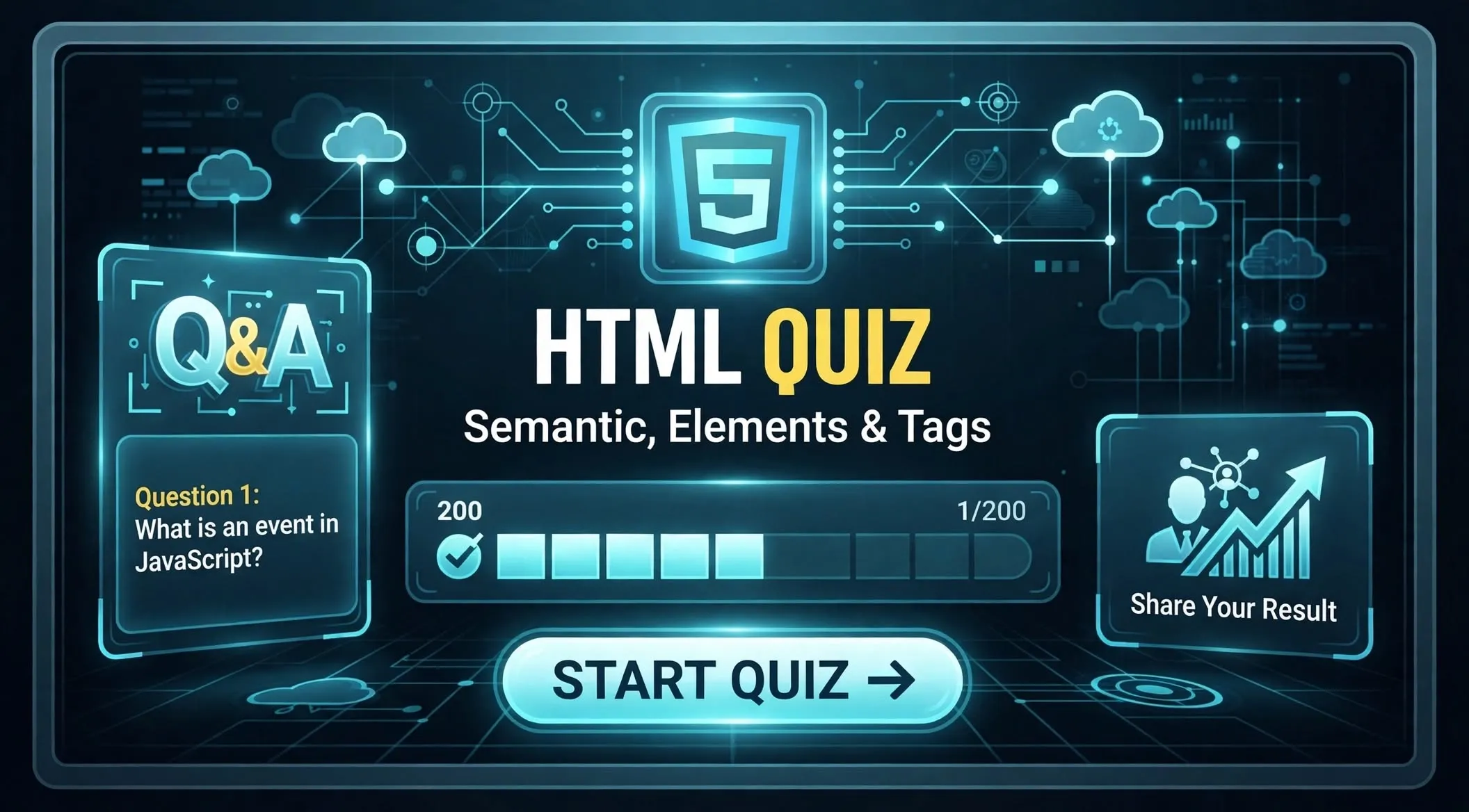
HTML Quiz: Semantic, Elements & Tags

This quiz tests your knowledge of HTML's semantic structure, essential elements, and proper tag usage. It is designed for aspiring and current front-end web developers.
HTML Quiz: Semantic, Elements & Tags
Welcome to the ultimate HTML Quiz for front-end developers! This interactive quiz helps you master the foundational concepts of HTML, focusing on semantic structure, common elements, and effective tag usage. Understanding these core principles is essential for building accessible, maintainable, and search-engine-friendly web pages.

TL;DR: What This Quiz Covers

  • The purpose and benefits of semantic HTML.
  • Correct usage of various HTML elements and tags.
  • Key HTML5 features and best practices.
  • Distinctions between elements, attributes, and the DOM.
  • Importance of HTML validation and Doctype.

Mastering HTML Fundamentals

HTML is the backbone of every web page. A strong grasp of its fundamentals is crucial for any web developer. This quiz explores how to use HTML effectively, moving beyond basic syntax to embrace best practices that improve web accessibility and performance.

Understanding Semantic HTML

Semantic HTML uses elements that convey meaning about the content they contain. Instead of just using generic <div> tags everywhere, semantic tags like <header>, <nav>, <article>, and <footer> describe the role of the content. This makes your code more readable for other developers and more understandable for browsers and assistive technologies.

Essential HTML Elements and Tags

The HTML specification includes a wide array of elements, each with a specific purpose. Knowing when to use elements like <p> for paragraphs, <img> for images, or <a> for hyperlinks is fundamental. This quiz will challenge your understanding of these common elements and their appropriate contexts.

HTML5 Features and Best Practices

HTML5 introduced many new features and semantic elements that streamline web development. Concepts like the Document Object Model (DOM) are also vital. The DOM represents the page structure as a tree of objects, allowing JavaScript to interact with and modify content, structure, and styles. Understanding these modern features and how to apply them correctly is a key skill for any front-end developer.

How the Quiz Works

This quiz draws from a bank of 76 questions. Each time you start, 30 questions are randomly selected to provide a fresh challenge. You will receive a score at the end, which you can share with friends or colleagues. Use this quiz as a study tool to identify areas for improvement and reinforce your HTML knowledge.

Study Tips for Success

To prepare for this quiz and improve your overall HTML skills, consider these tips:
  • Review the official MDN Web Docs for HTML elements and attributes.
  • Practice building simple web pages using semantic HTML5 elements.
  • Experiment with different HTML attributes and observe their effects.
  • Understand the difference between block-level and inline elements.
  • Learn about HTML validation tools and why they are important.
Ready to test your HTML expertise? Take the quiz now and solidify your understanding of semantic HTML, elements, and tags!

Frequently Asked Questions

What is the primary purpose of semantic HTML?
Semantic HTML uses elements that clearly describe their meaning to both the browser and the developer. This improves accessibility for assistive technologies, enhances SEO by providing better context to search engines, and makes code easier to read and maintain for other developers. It focuses on the content's role, not just its appearance.
How do HTML elements and attributes differ?
An HTML element defines a part of a web page, like a paragraph (<p>) or an image (<img>). Attributes provide additional information about an element, modifying its behavior or appearance. For example, the src attribute on an <img> element specifies the image file's path.
What is the Document Object Model (DOM) in HTML?
The Document Object Model (DOM) is a programming interface for web documents. It represents the page structure as a tree of objects, where each node is an object representing a part of the document. The DOM allows programming languages like JavaScript to access, manipulate, and update the content, structure, and style of a web page.
Why is HTML validation important for web development?
HTML validation checks your code against W3C standards, identifying errors like unclosed tags, incorrect nesting, or invalid attributes. Valid HTML ensures consistent rendering across browsers, improves accessibility for users with disabilities, and makes debugging easier. It helps create robust and reliable web pages.
What is the function of the Doctype declaration in an HTML document?
The <!DOCTYPE html> declaration tells the browser which HTML version the document uses. For HTML5, it's a simple declaration that ensures browsers render the page in 'standards mode,' preventing them from falling back to 'quirks mode,' which can lead to inconsistent rendering and layout issues across different browsers.

Related Quizzes